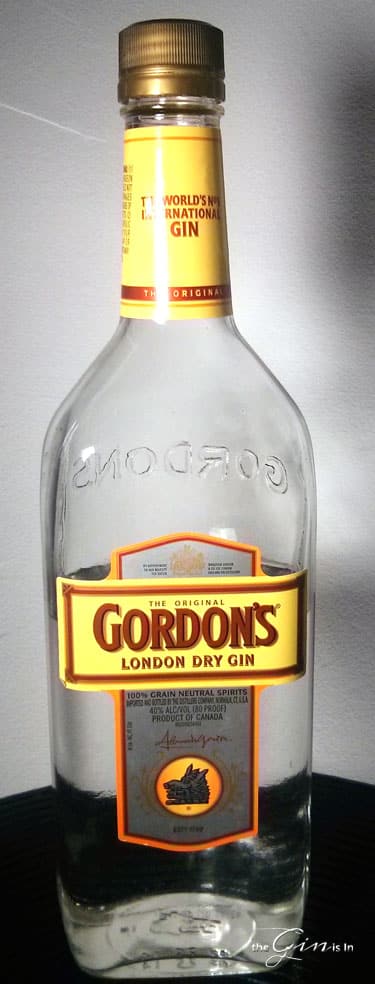
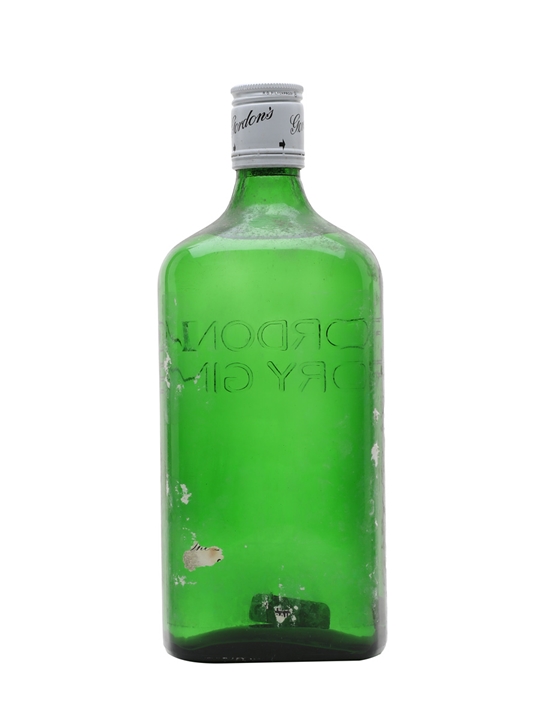

There's something quietly thrilling about handling a bottle of Gordon's from the 1970s. Not because it's rare in the collectible sense — Gordon's was, and remains, one of the most widely distributed gins on the planet — but because it represents a snapshot of what London Dry meant before the craft revolution rewrote the rules. This is Gordon's as it was: a workhorse spirit built for empire-scale distribution, bottled at 40% ABV, and designed to perform reliably in a Gin & Tonic or a Martini without ever demanding attention for itself.
A Window Into London Dry's Industrial Peak
What makes this bottle fascinating from an industry perspective is what it tells us about the category's centre of gravity before the botanical arms race of the 2010s. Gordon's in this era wasn't competing with seventy other gins on a back bar — it was the back bar, alongside a handful of peers. The recipe didn't need to shout. It needed to be consistent, juniper-forward, and utterly dependable. That commercial logic shaped everything about how this gin was constructed.
At 40% ABV, this sits at the standard strength for the period, before the trend toward navy strength and higher-proof expressions took hold. The London Dry classification tells you what to expect in terms of production method — redistilled with natural botanicals, no artificial additions, no sweetening after distillation. It's gin at its most disciplined.
I'd rate this 7.8 out of 10. It earns that score not for innovation but for historical significance and the quality benchmark it represented. This is a reference point, not a showpiece.
Best served: In a classic Martini, stirred, with a lemon twist — the way it would have been served in any respectable hotel bar of the era. That's where a Gordon's of this vintage earns its keep.